



The AI Computing Boom is Here—Are Distributors Ready?
From broadband access to GPU-cluster interconnects, AI is changing where fiber is deployed, how it is specified and what distributors need to stock.
Only a few years ago, fiber-optic demand was mainly associated with broadband access, FTTH deployments, mobile backhaul and telecom networks. The market was relatively mature, and distributors could build their product portfolios around familiar cable types and predictable project requirements.
AI infrastructure is changing that model.
Fiber is no longer simply the medium that delivers internet access to homes and businesses. Inside modern AI data centers, it acts as the physical nervous system connecting servers, accelerators, switches, racks, data halls and geographically separated facilities.
For distributors, this shift creates a valuable opportunity—but also introduces greater specification risk. Selling more fiber is only part of the opportunity. The real value lies in helping customers select the correct fiber count, connector interface, polarity, loss grade, cable construction and migration path.
AI Is Changing the Fiber-Optic Product Mix
According to CRU, optical-cable consumption for AI applications grew by 138% in 2024 and was forecast to grow by approximately 80% in 2025. CRU also projects a five-year compound annual growth rate of approximately 26% through 2029.
A 2026 public filing citing CRU estimates that the internal interconnections of a 10,000-GPU cluster can require approximately three to ten times as much fiber as a traditional data center.
The important point for distributors is not one isolated forecast. It is the structural change behind the numbers: AI clusters create far more east–west traffic between computing nodes, requiring denser and faster interconnections inside and between data centers.
Which Fiber Products Should Distributors Understand?
1. MPO High-Density Trunk and Breakout Cables
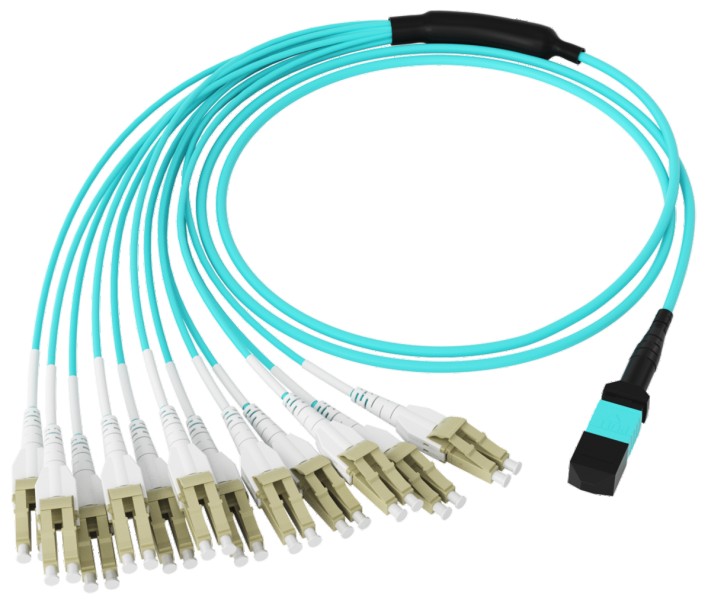
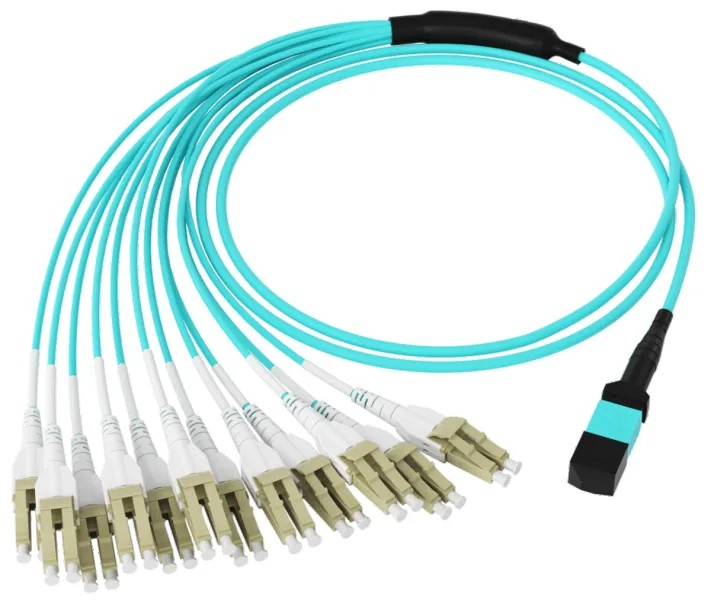
MPO assemblies combine multiple fibers in one connector interface. They are widely used between racks, patch panels, cassettes, switches and parallel-optics transceivers.
Common configurations include MPO-to-MPO trunks, MPO-to-LC breakouts, Base-8, Base-12, Base-16 and Base-24 systems, male or female connectors, UPC or APC interfaces, Type A/B/C polarity, OS2 or multimode fiber, and standard-loss or low-loss assemblies.
MPO is not a single interchangeable specification. Two cables that look almost identical may have different polarity, pin configuration or fiber mapping. That difference can determine whether the completed link works. The MPO connector family is standardized under IEC 61754-7, while the correct assembly still depends on the selected transceiver and cabling architecture.
2. OM3, OM4 and OM5 Multimode Fiber
Multimode fiber remains important for short-reach data-center connections because it can provide cost-effective connectivity when paired with compatible short-reach transceivers. Reach depends on the Ethernet or InfiniBand application, transceiver type, data rate, fiber grade, connector loss, connection count and total channel loss budget.
OM4 is widely used in existing high-speed data-center environments. OM5 can support shortwave wavelength-division multiplexing applications, but it should be recommended according to the customer’s actual transceiver roadmap—not simply because it is a newer fiber grade.
3. OS2 Single-Mode Fiber
OS2 single-mode assemblies are important for longer-reach links, data-center interconnects and architectures that use single-mode parallel optics. G.652.D is a common general-purpose option, while bend-insensitive G.657.A2 can be useful where routing space is more demanding. Selection should follow the link distance, bend-radius requirement, transceiver interface and optical budget.
4. Pre-Terminated Fiber Trunks
Factory-terminated trunks reduce field termination work and can shorten deployment time. They are especially useful in repeatable rack designs and projects where installation consistency matters.
Before ordering, confirm cable length and its measurement reference, pulling-eye requirements, breakout-leg length, cable diameter, jacket and flame-rating requirements, connector protection, label format and test documentation. A small error in trunk length or breakout orientation can become a major problem when hundreds of assemblies arrive on site.
5. MPO Cassettes, Adapter Panels and Patch Panels
MPO trunks are normally part of a complete connectivity system. Cassettes and panels provide transitions between trunk cables, duplex connections and equipment ports. Distributors should sell these components as a coordinated system whenever possible to prevent compatibility gaps.
6. 400G, 800G and Emerging 1.6T Connectivity
Higher speeds do not automatically require the same connector or fiber count. Depending on the transceiver, a 400G or 800G link may use LC duplex, MPO-8, MPO-12, MPO-16, twin MPO or another interface. This is why the transceiver part number should be confirmed before the distributor finalizes the cable configuration.
Emerging Fiber Technologies: Important, but Not Yet Standard Inventory
Hollow-core fiber, multicore fiber and polarization-maintaining fiber may play important roles in future low-latency, high-capacity and specialized optical systems. However, these products should currently be treated as project-specific opportunities rather than routine inventory for every distributor. A disciplined distributor separates products customers need today from technologies that should be monitored for future demand.
Why MPO Is a Strategic Product for Fiber Distributors
As GPU clusters expand, the number of high-speed connections grows rapidly. Using individual duplex patch cords for every link can increase cable volume, installation time and operational complexity. MPO connectivity addresses this problem by supporting multiple fibers through one compact interface.
- Higher order value than basic duplex patch cords
- Opportunities to supply trunks, breakouts, cassettes and panels together
- Extensive configuration and private-label options
- Repeat demand from phased data-center expansion
- Technical differentiation beyond price alone
- Opportunities to support network migration and port breakout
The same flexibility also creates risk. Incorrect polarity, gender or fiber mapping can make an entire batch unusable. Successful distributors compete through specification accuracy and dependable quality—not simply the lowest unit price.
Ten Questions to Ask Before Quoting an MPO Cable
- What are the exact transceiver or equipment part numbers?
- Is the application 40G, 100G, 200G, 400G, 800G or another rate?
- Is the required fiber OS2, OM3, OM4 or OM5?
- Is the system based on 8, 12, 16 or 24 fibers?
- Does the customer require MPO-to-MPO or MPO-to-LC?
- Should the MPO connector be male or female?
- Is UPC or APC polishing required?
- Is the required polarity Type A, Type B or Type C?
- What insertion-loss limit must the completed assembly meet?
- What jacket, labeling, test-report and packaging requirements apply?
These questions protect the distributor from one of the most common problems in high-density cabling: ordering a technically good cable that is incompatible with the customer’s system.
How LinkFiber Supports Distributors and Project Suppliers
LinkFiber MPO fiber assemblies can be configured for data centers, telecom networks, LAN/WAN systems, patching environments and active-equipment interconnection.
Project options can include MPO trunk and breakout configurations, different fiber counts and fiber types, Type A/B/C polarity, male and female options, UPC and APC interfaces, customized cable and breakout lengths, project-specific labels and packaging, and standard-loss or low-loss requirements.
Applicable IEC, Telcordia, YD/T and cable-flammability requirements should be confirmed according to the selected model, destination market and project documents before production.
Our goal is to help distributors reduce specification mistakes, control purchasing risk and supply products that protect their reputation with end customers.
A Practical Stocking Strategy for Distributors
Distributors do not need to stock every possible MPO configuration. A more practical model combines frequently requested standard assemblies for immediate delivery, configurable products for project orders, samples for customer qualification, clear specification forms and pre-production confirmation for polarity and fiber mapping.
Are You Ready for the Next Fiber Market?
AI infrastructure is creating genuine demand, but customers need distributors who understand how transceivers, fiber type, connector interfaces, polarity and optical budgets work together.
If you distribute fiber-optic products or supply data-center projects, LinkFiber can help you develop an MPO product mix for your target market—from standard patch cables to customized trunk and breakout assemblies.
Sources
FAQ
What quality documents should B2B buyers request for MPO cable projects?
What information should a distributor provide when requesting an MPO trunk cable quotation?
Why are MPO polarity and connector gender critical in bulk cable orders?
Which fiber type is better for an AI data center: OM4, OM5 or OS2?
How do buyers choose MPO-8, MPO-12, MPO-16 or MPO-24 for 400G and 800G links?
What MPO fiber cable configurations should distributors stock for AI data centers?
Professional Consultation
If you are interested in our products and would like to know more details, please leave a message here, and we will get back to you as soon as possible.


